Devpost
Participate in our public hackathons
Devpost for Teams
Access your company's private hackathons
Grow your developer ecosystem and promote your platform
Drive innovation, collaboration, and retention within your organization
By use case
Blog
Insights into hackathon planning and participation
Customer stories
Inspiration from peers and other industry leaders
Planning guides
Best practices for planning online and in-person hackathons
Webinars & events
Upcoming events and on-demand recordings
Help desk
Common questions and support documentation
This is a code that longitudinally models Alzheimer's disease progression for more clinical relevance while incorporating powerful interpretability features.
Using Vision Transformers to achieve 94.5% accuracy in Alzheimer's detection from brain MRI scans, our solution handles class imbalance, trains in 50 mins, and provides reproducible coding environment
Explainable AI for early Alzheimer's detection—fusing cognitive, imaging, and genetic biomarkers to identify at-risk patients before symptoms progress.
A. Graph Neural Network Modeling of Tau Protein Misfolding in Alzheimer’s Disease and Related Tauopathies
An explainable AI system that predicts Alzheimer’s disease by combining clinical data (XGBoost + SHAP) with CNN-based MRI analysis for accurate and trustworthy risk assessment.
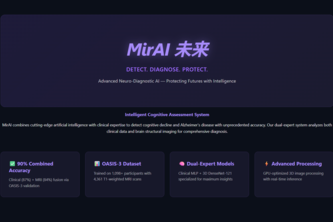
MirAI (未来): A Dual-Expert AI System for Early Alzheimer’s Detection through 3D Neuroimaging and Cognitive Analysis.
92% accurate machine-learning early-warning system that detects patterns in sleep, mobility, and vitals from passive smart-home sensors to predict adverse health events in dementia 14 days in advance.
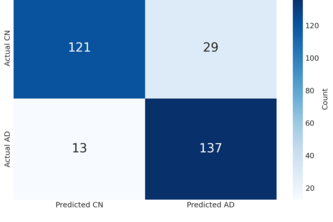
We achieved 71% accuracy detecting Alzheimer's using blood biomarkers and cognitive tests from the Bio-Hermes dataset, proving that cheap, accessible screening can replace expensive brain imaging.
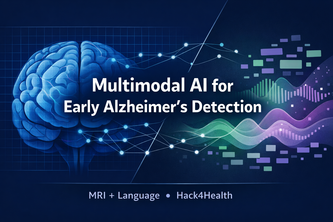
Multimodal Superintelligence for Early Alzheimer’s Diagnosis, 97.3%>(MRI) and 88-95%>(EEG) accuracies for the respective segments.
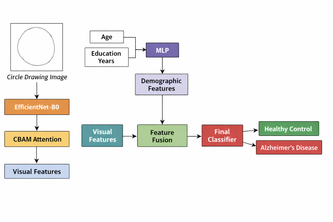
Early Alzheimer’s detection from handwritten drawings using attention-based multimodal deep learning.
This project combines MRI data from OASIS-1 with speech & language data from Pitt Corpus to create a late-fusion based dementia classifier. It also uses this to evaluate their dementia severity.
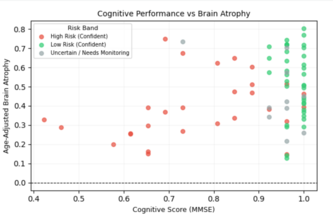
An interpretable Alzheimer’s risk stratification system that combines cognitive scores and age-adjusted brain atrophy to explicitly surface uncertainty and support safer early screening.
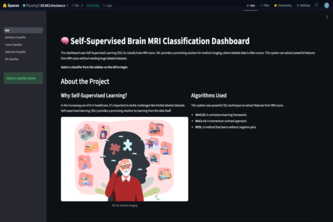
Using Self-supervised learning(SSL) model to understand Alzheimers/Tumors Pattern through MRI images to perform classification and providing visual assistance to clinicians to study the MRI
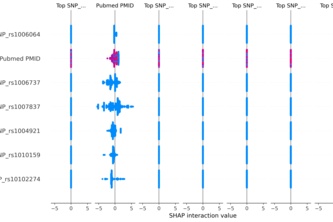
Fuses Genetics & MRI Radiomics to detect Alzheimer’s. Unlike CNNs, our XGBoost engine provides clinical rationale via SHAP, achieving 97.53% accuracy on blind external data.
We built an Explainable AI model (98.9% accuracy) that uses simple genetic variants to predict 9 distinct Alzheimer's phenotypes, replacing expensive brain scans with accessible genomic screening.
An interpretable AI model that predicts early Alzheimer’s risk and progression from clinical data using robust machine learning and SHAP explainability for transparent clinical decision support.
MRI Scan Analyzer using CNNs + Clinical Cognitive Assessment Simulation that doctors employ IRL; final diagnosis using MRI embeddings + weighted Cognitive Scores.
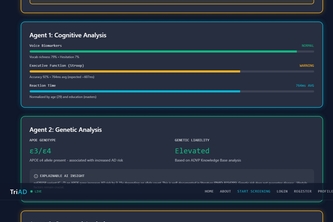
TriAD triangulates voice biomarkers, genetics, and MRI AI for precision Alzheimer's screening and early risk detection.
NeuroPredict uses machine learning to detect early signs of Alzheimer’s disease from clinical data, supporting timely diagnosis and better treatment planning.
A second set of eyes for Alzheimer screening: an MRI model that flags at-risk scans with probability scores and prioritizes early detection with fewer missed cases.
An AI-powered system for early detection of Alzheimer’s disease using MRI-based deep learning.
We classify Alzheimer’s disease at the patient level using paired light–dark retinal OCT by explicitly learning functional differences and aggregating them with attention-based MIL.
FEVER ORACLE predicts fever outbreaks 10-14 days early by integrating environmental, pharmacy, and clinical data. It offers personalized patient risk modeling and real-time cross-institutional alerts.
A Python based medical image analysis program that examines MRI scans to explore early structural brain changes associated with Alzheimer’s disease and identify potential risk indicators.
1 – 24 of 157